Book Review: Janiak's Enlightenment's Most Dangerous woman.
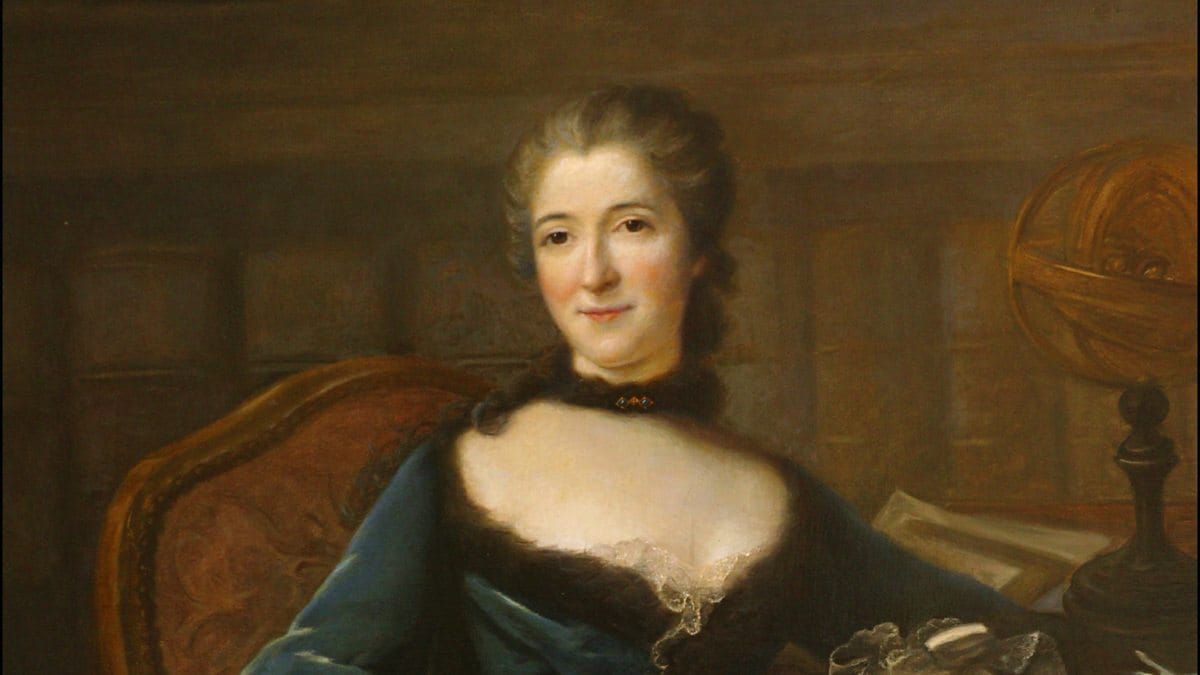
Andrew Janiak’s Enlightenment’s Most Dangerous Woman serves as an impassioned, well-reasoned argument for Émilie du Châtelet's inclusion in the canon of Philosophy. Janiak grounds his research in the well-documented writings of Émilie du Châtelet, in which she tackles many of the fundamental problems ongoing in both philosophy and physics. Despite her numerous contributions and evidential interactions with the discipline’s titans, Émilie du Châtelet is notably absent from most encyclopaedic texts covering the era’s foremost thinkers, both in her time and in ours. In this essay, I will argue that Janiak successfully demonstrates that Émilie du Châtelet was indeed an influential figure in Philosophy and Science. Specifically, I will examine how the book's greatest strength lies in the reconstruction of her contributions to live debates, with a focus on her unique non-partisan approach in discussions such as that on absolute space. Additionally, I will address a critical limitation in Janiak's narrative, namely his tendency to over-romanticise du Châtelet’s actions by attributing strategic intent to her publication history. While this interpretative approach is plausible, it represents the chief weakness in an otherwise historiographically sensitive work of intellectual history.
Andrew Janiak is a Professor of Philosophy at Duke University. His book is part of his overarching effort known as “Project Vox,” a project aiming to restore and highlight the achievements of marginalised philosophers who were excluded from the canon (2024, p. xi). Émilie du Châtelet is particularly influential, as her translation of Newton’s Principia into French is still the most widely used copy in France, as well as including her own calculations and additions to his work (2024, pp. 118–122). Janiak achieves something spectacular with his latest book, as most discourse on Émilie du Châtelet surrounds her infamous affair with fellow French Philosopher Voltaire. The hyper-focus on the romance of her life and her portrayal as a sidekick to a great male philosopher is extremely disingenuous, as Janiak correctly argues; Émilie du Châtelet’s contributions to the fields of Metaphysics and Physics greatly outweigh those of her former lovers (2024, pp. 18–20, 121–122). A comprehensive book analysing Émilie du Châtelet from the perspective of philosophy, rather than general biographies and romantic portrayals, proved vital for a truly comprehensive understanding of Enlightenment France (2024, pp. 18–20).
Building upon the context of her marginalisation, Janiak's overall argument is that Émilie du Châtelet was purposefully excluded from the philosophical canon and that her works and contributions have earned her a rightful place in the Enlightenment’s brightest minds (2024, pp. 17–18, 23). Janiak argues this through reviewing her primary texts and engagements with other philosophers in the republic of letters (2024, pp. 17–18, 119–123). Émilie du Châtelet’s most elusive text, Institutions de physique, is the main component of his argument (2024, pp. 119–123). In which Émilie du Châtelet tackles numerous topics across the foundations of physics and metaphysics (2024, pp. 122–125). Janiak evaluates her interactions with other philosophers, her presence in the works of influential figures such as Wolff, Formey, and Brucker as evidence of her influence, as well as her anonymous publications and growing notoriety in the Republic of Letters (2024, pp. 121–123). Utilising primary texts across philosophers in Émilie du Châtelet’s sphere of influence, primarily analysing her Institutions de Physique, philosophical encyclopaedias and transcripts of the intellectual sphere in Europe at the time, notably the Académie Française and the Royal Society, Janiak provides a comprehensive overview of all the scientific and philosophical developments at the time, and does a superb job at explaining the rigorous and often tangential scientific debates at the time. Notably, the debate on Absolute space, a primary tension between Newton and Leibniz, is explained thoroughly well, with a literal, understandable explanation of complex (not to mention outdated) qualms in physics (2024, pp. 56-62). The context of the book is succinct, understandable, and written both professionally and yet surprisingly understandable for someone not thoroughly educated in Physics or Mathematics. Of course, some of the prose and debates at the time are dense, and a literate understanding of Philosophy, physics and mathematics is beneficial to truly grasp Janiak’s arguments.
The strongest component of the book is Janiak’s clear and consistent exposition of Émilie du Châtelet’s ingenuity, mathematical and philosophical prowess, and her ability to situate herself in live debates. Janiak demonstrates this throughout the book, with clear, academic analysis of her works and how they separated her from her peers. An overarching point of discussion is Émilie du Châtelet’s opinions on intellectual idolatry. Janiak often ties back the developments in science at the time to du Châtelet’s vision of science and philosophy. Instead of championing a singular “hero” of the Enlightenment or any given movement, as was normal and done by her contemporary and former lover Voltaire, du Châtelet viewed science as a building constructed by hundreds of people, not a singular problem solved by a hero. du Châtelet was notably the first person to declare a “revolution” in the sciences, despite this being accredited to many male figures in her milieu. This pluralistic and revolutionary view was co-opted in the Preliminary Discourse to the Encyclopaedia by D’Alembert, reproducing her framework and neglecting to credit her. Furthermore, a young Kant was influenced by this idea from her Institutions, adopting that philosophy must mirror the scientific revolution by situating itself historically, and effecting a comparable “Revolution” in thought, as argued by du Châtelet before (2024, pp. 9–16). I would like to focus on the specific criticism of “Idolatry in Philosophy, outlined in the opening preface to her Institutions:
“I believe it even more necessary to advise you not to carry respect for the greatest men to the point of idolatry, as the majority of their disciples do.” (Du Châtelet, E. 2009, p.122)
Janiak, across Chapter 1, illustrates this. Émilie du Châtelet’s genius was unique not just in her mathematical and philosophical prowess, but within her principles, which underpin the foundations of most of her works. It is important to note this position, as much of Janiak’s exposition of du Chatelet’s contributions can be traced back to this point, with several of her metaphysical and physical arguments alike converging on this point of view. She regularly avoids taking a “side” in a debate, instead arguing both sides, finding strength in each, and presenting a clear conversation to be had. du Châtelet’s “danger” stemmed from her refusal to fit the conventions of her milieu, her criticisms of Voltaire in the beginning of her institutions for idolising Newton in his works categorically dismantles her reputation as his “sidekick.”
Émilie du Châtelet’s aptitude for original critique, synthesis and her non-partisan methodology is demonstrated throughout the book (2024, pp. 1–5). Janiak illustrates her daring throughout the book, but particularly well in Chapter 3, specifically the section “A novel approach to space”, which I will focus on for this section of the argument (2024, pp. 87–93). The debate as it stood was between Clarke (A Newtonian) and Leibniz (2024, pp. 87–88). Newton had previously argued that space is absolute, real, and exists independently of matter; moreover, it is fundamentally required to make sense of true motion and the law of inertia (2024, pp. 87–88). Leibniz, on the other hand, viewed space as relational, nothing over and above relations between bodies (2024, p. 88). Principally, absolute space violated the Principle of Sufficient Reason; there was no true reason for space to exist, if it did, it would be an anomaly (2024, pp. 88–89).
Du Châtelet quickly agrees with Leibniz’s metaphysical conclusion; she argues that absolute space is indeed metaphysically extravagant and endorses his invocation of the Principle of Sufficient Reason as a correct objection to Newton and Clarke (2024, pp. 88–89). Janiak highlights that she immediately avoids becoming partisan to Leibniz; she does not treat the nature of space as the end of the debate (2024, p. 89). Instead, she posits an epistemological/psychological question, “Why does Newton’s view still remain so compelling, even if it is wrong?” (2024, p. 89). Du Châtelet argues that Newton’s argument is right in our phenomenal experience of space (2024, pp. 89–90). She asserts that when we imagine removing all objects from a region, Janiak uses the example of removing every item from his office, we still imagine empty space where those objects were, not a complete lack of space (2024, pp. 89–90). Crucially, she does not infer that Newton is right because his view feels intuitive; she explains why he came to that conclusion, why it is reasonable, and why it was a good argument (2024, p. 90). Janiak argues that this psychological fact explains the source of the illusion of absolute space, not its correctness, a philosophically sophisticated move (2024, pp. 90–91). Janiak emphasises that had Du Châtelet truly been partisan, she would not have spent so much time and effort explaining the appeal of an opposing view (2024, p. 91). She reframes a metaphysical dispute as a multi-level problem involving fundamental ontology (what exists), physics (what theories require, and evidence we have) and psychology (how we interpret the world) (2024, pp. 91–92). This move explains persistent disagreement, avoids false victory declarations, and dissolves dogmatism successfully (2024, p. 92).
The sophisticated exposition of Du Châtelet’s role and ingenuity in live debates at the time is the strongest point of the entire book. This is done several times, notably in discussing gravity and matter: The Newtonians argued gravity was a fundamental law of nature, a primary quality of matter, while Leibniz argued that gravity required a sufficient reason or mechanism to be considered essential, where Du Châtelet accepts Leibnizian demand for intelligibility, while siding with Newton that his law of inertia establishes how gravity operates but does not entitle us to claim what gravity is, so philosophy must suspend commitments and speculative mechanisms (2024, pp. 73-74, 80-91). Here, Du Châtelet sides with Newton instead of Leibniz, demonstrating her intelligence and lack of partisanship. Janiak provides several more examples of this and overall successfully demonstrates Du Châtelet’s prowess proves why she ought to be reintroduced to our philosophical canon.
The weakness in Janiak’s otherwise rigorous and excellent account lies in his narrative framing of Émilie du Châtelet’s actions. Most notably in his reconstruction of her public dispute with Dortous de Mairan during the vis viva debate. Janiak explicitly frames Du Châtelet’s early praise of de Mairan’s work as a deliberate trap, writing after his exposition of said praise: “Little did Mairan know, she had set her trap” (2024, p.124), he characterises her entire publication strategy, of replying publicly, forcing a response and republishing exchanges as a “wily maneuver” (p.125), that ensnared the secretary of a powerful institution into a public debate. This romantic interpretation is reinforced through dramatic narrative language and rhetorical flourish, resulting in his claim that these calculated moves placed Émilie du Châtelet in such a prestigious position that she could now decidedly debate these monolithic figures.
While this reading is plausible, it risks exceeding what the historical evidence strictly demonstrates. The record shows a sequence of publications, replies, and institutional responses. This was standard in academic circles at the time, and there is little evidence to suggest this was planned rather than emerging contingently from the rising prominence of the Institutions de Physique. Philosophers often develop new understandings and criticisms of work they once agreed upon. A more conservative interpretation might explain this episode as a standard escalation of Enlightenment controversy, shaped by institutional exclusion and publicity, rather than a calculated ambush. This presents a broader narrative risk of the book; Du Châtelet is often presented as consistently self-aware and operates above her milieu, which subtly romanticises her agency. The irony in this is that Janiak emphasises du Châtelet’s own critique of intellectual idolatry and discipleship, yet sections like this risk reproducing the same mythic exceptionalism she disliked about Newton. However, crucially, this does not undermine Janiak’s philosophical reconstruction of Émilie du Châtelet’s views, but suggests his historical narration is occasionally more confident than the evidence strictly licences.
Overall, Janiak’s Enlightenment’s Most Dangerous Woman is an incredible work of intellectual history. Janiak does a sufficient job of demonstrating the need to recognise Émilie du Châtelet as a key figure in the history of philosophy. I would argue that parts of the text are essential to any lecturer assembling a class on Early Modern Science, as Janiak has clearly proven: leaving Émilie du Châtelet’s work outside of our history is disingenuous considering their impact. This book would be a useful read to anyone interested in the history and philosophy of science, whether inside or outside of academia.
Bibliography:
Janiak, A. (2024). The Enlightenment’s Most Dangerous Woman: Émilie du Châtelet and the Making of Modern Philosophy. Oxford: Oxford University Press.
Du Châtelet, É. (2009). ‘Foundations of Physics’. In J. P. Zinsser & I. Bour (eds), Selected Philosophical and Scientific Writings. Chicago: University of Chicago Press.