The Myth of Universal Causes.
If you are interested in this topic, I made a video essay on it: https://www.youtube.com/watch?v=PJ1HRWMRMDw&t=231s
To what extent is Universal Causation (the claim that ‘whenever C, E’) necessary for an adequate metaphysical account of causality, and can a theory of Local Causation provide a superior alternative?
Causation remains a fundamental problem within metaphysics, yet many of its classical and contemporary accounts implicitly rely on a phenomenon I call the Universalist Thesis (UT): the argument that a causal relation is always supported by some exceptionless, type-level generalisation linking cause and effect. This structure appears in Humean conjunction, Mill’s invariable succession, Mackie’s disjunctive sufficiency, and Lewis’ law-preserving counterfactuals. In this essay, I argue UT is not necessary for an adequate metaphysics of causation. I contend that causal powers are best understood as structurally embedded capacities, whose effects depend on local context, positing Local Causation (LC) as a superior alternative. I proceed by (1) showing how UT is found in major accounts on causality, (2) drawing on recent power theory and philosophy of science to motivate a local ontology of causation, and (3) presenting Brunet’s framework of LC as both capturing this locality, and undercutting any methodological motivation for UT.
In the following section, I will demonstrate UT’s placement in major classical theories of causation. Hume directly committed to UT, through defining causation as a constant conjunction of whenever A, then B (under certain conditions C) (Enquiry, Section VII.1). A cause is simply an object, and where all objects like it are regularly followed by an identical effect. Thus, Hume’s account argues that causal relations are supported by exceptionless generalisations. This basic idea will be expanded into appeals to “relevant conditions[1],” or relativity to fixed laws (Lewis). Minimally it can be viewed as:
Whenever C occurs, E occurs.
Mill on the other hand explicitly embeds UT, through defining a cause as the antecedent, which it invariably and unconditionally follows (1843, p.35). He later argues that causal laws are laws of invariable succession, which reinforces this universalist notion (1843, p.39). For Mill, the ontological nature lies within the succession between antecedent and consequent, C àE, committing him invariably to UT. Unlike Hume and Mill, Mackie’s account initially rejects any notion of UT, but in fact preserves a more complex universalist structure beneath the surface. Mackie’s pivotal claim is that a “cause” is rarely either necessary or sufficient on its own; instead, it is typically an INUS condition “an insufficient but necessary part of an unnecessary but sufficient condition.” (Mackie, 1965, p.246).This can be understood as C will cause E only when it forms one conjunct within a larger complex F, and this larger F is one member of a wider disjunction of minimally sufficient conditions for E (Mackie, 1965, pp.247-248). Mackie assumes that the entire disjunction is a necessary and sufficient condition for the effect, explicitly noting this as a necessary and sufficient condition for P (Mackie, 1965, p.247). This commits him to a UT of the form: for all cases within a causal field F, E occurs iff one of the sufficient complexes occurs. This thesis does not abandon UT but repackage it within a universal commitment at the level of the disjunctive condition, notably, that whenever the total set of sufficient conditions holds, the effect follows (Mackie, 1965, p.252).
Lewis provides the best account of causation amongst these authors, abandoning the notion of regularity, but retaining UT through his law-preserving counterfactual arguments. Lewis initially rejects regularity theories, as he argues they confuse causes with effects, epiphenomena, and pre-empted causes (Lewis, 1973, p.560). This analysis motivates his initial deviation from the Humean norm. Lewis demonstrates his account of causation with a counterfactual analysis:
E depends causally on C iff (¬C □ -> ¬E) is true (Lewis, 1973, p, 560).
To figure out which worlds are “nearest,” Lewis introduces a similarity ordering: some “possible worlds” are more like ours than others. (Lewis, 1973, p.559). The crucial role within this ordering is that worlds that keep all the actual laws of nature the same are automatically closer than any world that remotely violates them (Lewis, 1973, p.560). So, to ¬C, we can only consider worlds that preserve our actual laws and differ from the actual world as little as possible. Within this framework, his laws become the new universal structure, True-law propositions (L) tackle both explanatory and counterfactual work, and within this framework, every causal judgement presupposes the same nomic backbone. If (¬d □ -> ¬e) and (¬c □ -> ¬D), then c is a cause of e even when ¬c would not prevent e (Lewis, 1973, pp.563-564). The actual laws here form part of the similarity ordering: worlds that violate these laws are automatically more distant than those that preserve them (Lewis, 1973, pp.560-561). Conclusively, the laws do not merely describe regularities, they structure the counterfactual evaluation that defines causal dependence. Lewis proceeds to formalise this law-preserving structure through families of alternative antecedents A1, A2…; a proposition B is counterfactually independent of these alternatives iff all the conditions Ai □ -> B hold (Lewis, 1973, p.561). Illustrating the counterfactual truth is globally constrained by a singular system of laws, committing Lewis to the established idea of universalist thesis. Like Mackie, even though Lewis abandons explicit regularity; he still retains a universal metaphysics, in which every causal judgement presupposes a fixed, global, law-governed structure, which argues some implicit “law of nature” is ontologically necessary.
Causation has been recently evaluated by philosophers of science, notably Dupré and Cartwright (Dupre, 2021, pp. 1-15; Cartwright, 1999, pp. 1-79). Recent scientific research has shown that organisms and systems are not so much logical, but rather, plastic, variable, and context dependent (Dupré, 2021, p.11). The metaphysical implication here is that our actual causal structure is not universally law-governed; it is locally organised. Every organism has their own causal structure, their behaviours depend on a wide array of factors, ones in which C may not always intuitively cause E. A clear example comes from Agouti (A ^vy) gene in mice. Genetically identical mice carrying the A^vy allele do not exhibit the exact same phenotype: the same gene in different environments produces yellow fur, obesity, and diabetes; in others it is epigenetically silenced, and the mice are able to develop typically with brown coats (Dolinoy et al, 2006, pp.567-569). The effect of the same cause depends on local context: methylation patterns, maternal nutrition, and early embryonic signalling. This demonstrates the point that biological entities possess capacities, rather than universal effects, and those capacities become causally operative only within the right context (Dupré, 2021, pp.7-10). There is no law of the form “Whenever A^vy, à yellow coat,” let alone “Whenever C -> E.” Causal truth is structurally local and system dependent. These arguments feed into a wider argument: mechanisms as the real ontology of causation. Mechanisms can be defined as parts + organisations + capacities à effect. Causation here is the operation of organised mechanisms, rather than the instantiation of universal pattern, with scientific study revealing the need for a locally justified account of causation. Dupré discusses two types of causation:
(1) Downward: Parts depend on wholes, e.g., receptor protein’s capacities depend on organismic context (2021, pp.11-15).
(2) Upward: wholes depend on parts; their stability arises from the part’s coordinated activity (2021, pp.11-15).
A defender of UT might posit that there must still exist a maximally specific law here: whenever A^vy occurs with the totality of background conditions K, the phenotype follows. This however simply reinterprets what Dupré shows: organisms exhibit both upward and downward causal dependence. In such case, no type-level power of the gene alone determines the outcome; the organised mechanism {C + K} does the causal work, its effect derived from its context. As K is refined, the alleged “law” collapses into a description of that structure, making UT trivial, C now depends on the local mechanisms for E to occur.
The point is not simple biological outcomes vary, or that we should follow the word of science dogmatically, but rather that this variability exposes a deeper ontological structure. I argue that causal powers ought not to be seen as intrinsic universals carried by C; but rather relational capacities, whose manifestations depend on the local configurations in which they occur. Causation here consists of a process of derivation rather than the instantiation of an exceptionless law and therefore need not entail universal regularity or nomic necessity (Anscombe, 1971, pp.6-7). Capacities do not guarantee their effects, but rather manifest only through reciprocal interaction with other operative factors in an environment (Mumford & Anjum, 2011, pp.144-147). Biology here serves as a model which illustrates a general metaphysical claim: if we can accept causality as partially locally derivative, then any universal generation cannot be a necessary condition for causal truth, therefore an adequate account should treat this structural context as part of the causal ontology itself, not as a mere external qualification.
If structural embedding is taken as ontologically primary, locality proves itself as a superior, more flexible methodological option. Brunet’s framework of local causation provides a formal expression of this view, by evaluating causal claims relative to regions in which structural configuration varies:
(LA) C is locally a cause of E iff
(1) C is a cause of E at some location u, and
(2) (potentially) C is not a cause of E at some distinct location V.
` (Brunet, 2021, p.10890).
This approach follows Brunet’s recent defence of local causation, which argues that locality is not an ad hoc restriction, but rather a structural feature of how to obtain causal truths(Brunet, 2021, pp.10887-10890). This now shifts the conceptual burden from universality, onto the locality of metaphysical grounding. The structural dependence of causation now depends on the local ontological properties. UT fails here as it requires a form of modal invariance, that in all worlds where C occurs and laws hold, E follows. Yet, we can conceive of a world where all the laws remain, C occurs, and yet structural context differs -> no E. In fact, a modal analysis is not needed, we can conceive of this in our world. Let C’s causal power be grounded in relational structure S here, if S varies while laws and C do not then: C’s causal role is variable without any nomological variation.
To prevent this argument, the universalists place C causing E under C occurring with relevant conditions. Hume observes this phenomenon in his text, arguing that when analysing times where causation varies (A rhubarb failing to purge, opium failing to sedate) philosophers ascribe this not to any irregularity in nature, but in secret causes that prevent the operations (Hume, Enquiry, Section VI, pp.56-58). The relevant conditions here serve as secret causes, and are just the structural embedding of S, if S is required to fix the causal outcome, then; UT has smuggled a modicum of locality in, the universal claim is seemingly trivial, and the causal explanation is no longer grounded on the universal claim C à E. As if CàE depends on specifying S, then that causal relation supervenes on S and not on C. Once causal dependence is recognised as structurally grounded, UT fails, causal truths vary with changes in structure even when nomological structure is held fixed.
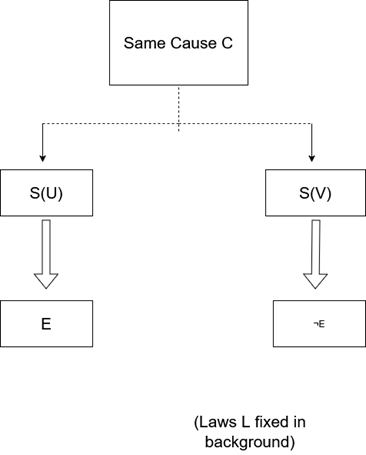
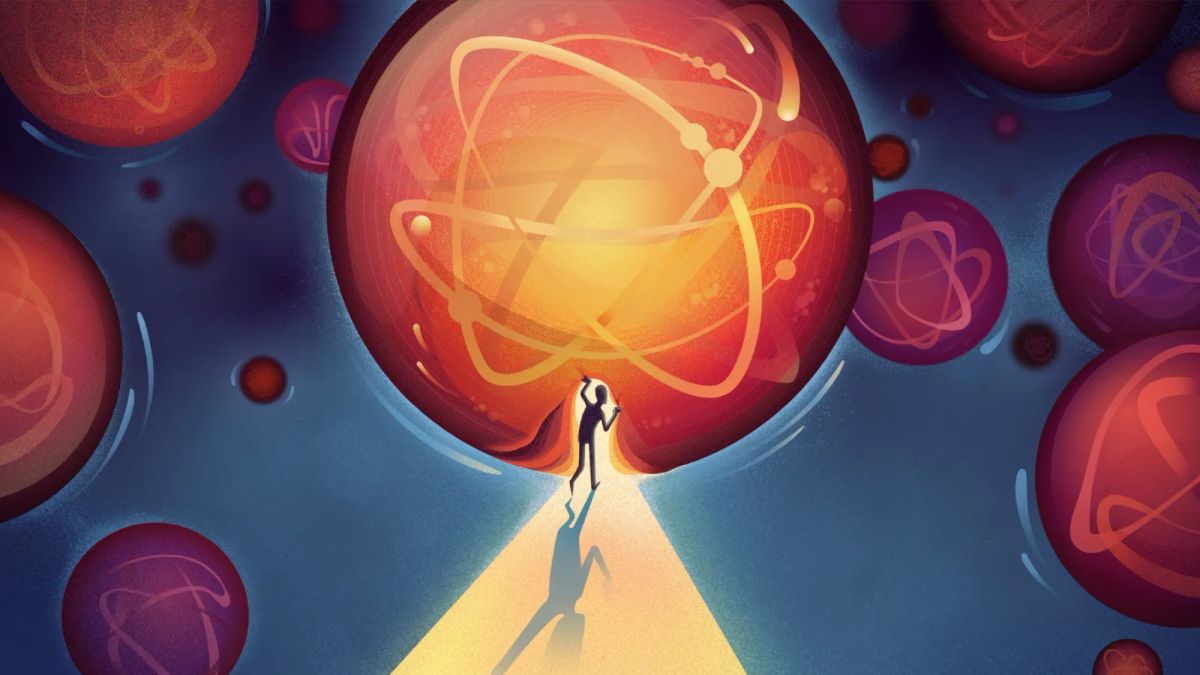
Now that we have argued that UT fails, and why a local account of causation is necessary, it is imperative to define local causation (LC) illustrated in Figure 1. LC can be understood as an account of causation where cause and effect are determined on the specific ontological context they are in. Imagine a simple light switch, in circuit U, flipping the switch completes the wiring and turn the light on. But turning the same switch does not turn on circuit V and does nothing. The mechanics of the switch stays the same, the laws of electricity and physics and stagnant, but only the local wiring configuration differs. The switch’s causal power is grounded in the local structure of the circuit. UT cannot accurately explain this without describing the wiring as a ”relevant condition,” but then the causal dependence lies upon the structure, not on C.
LC can be stated formally as:
A causal claim “C causes E at location U” is true iff:
1. C is embedded in structural configuration S(U),
2. S (U) grounds a derivational process P such that:
(LC-Process) (C ^ S(U)) -> E,
3. There exists at least one distinct location V such that S(V) ≠ S(U), and in virtue of this difference, the truth-value of “C causes E” might differ between U and V.
LC evaluates causal claims de locus, grounding them in structure, rather than de re, as UT does, treating C as a necessity Brunet, 2021, p.10892). LC supersedes any requirement that “C causes E” be a type-level necessity; causal powers are realised to structural embeddings, not carried intrinsically by C. In light of structural locality, universal generalisations become explanatorily redundant.
Bibliography:
Anscombe, G.E.M. (1971) Causality and Determination. Cambridge: Cambridge University Press.
Brunet, T. (2021) ‘Local Causation’, Synthese, 199(3), pp. 10887–10904.
Cartwright, N. (1999) The Dappled World: A Study of the Boundaries of Science. Cambridge: Cambridge University Press, pp. 1–79.
Dolinoy, D.C., Weidman, J.R. and Jirtle, R.L. (2006) ‘Epigenetic gene regulation: linking early developmental environment to adult disease’, Environmental Health Perspectives, 114(4), pp. 567–569.
,Dupré, J. (2021) The Metaphysics of Biology. Oxford: Oxford University Press, pp. 1–15; 7–10; 11–15.
Hume, D. (2008) An Enquiry Concerning Human Understanding. Edited by P. Millican. Oxford: Oxford University Press (Section VII.1; Section VI, pp. 56–58).
Lewis, D. (1973) ‘Causation’, The Journal of Philosophy, 70(17), pp. 556–567.
Mackie, J.L. (1965) ‘Causes and Conditions’, American Philosophical Quarterly, 2(4), pp. 245–264.
Mill, J.S. (1843) A System of Logic. London: Harrison and Co., pp. 35, 39.
Mumford, S. and Anjum, R.L. (2011) Getting Causes from Powers. Oxford: Oxford University Press, pp. 144–147.
[1] Background factors that must be held fixed to tell whether an event causes another or not.